
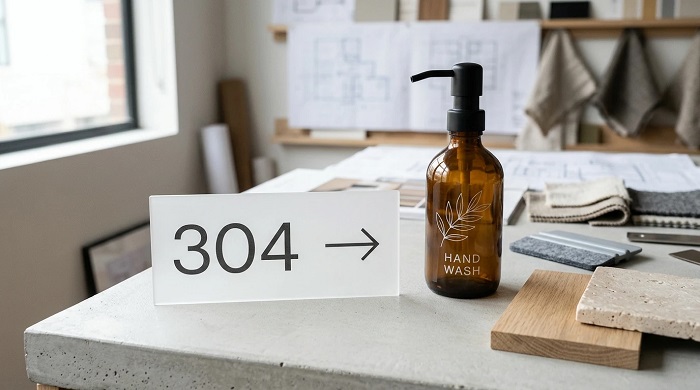
When a boutique hotel, co-working floor, or residential development reaches the final fit-out stage, print and signage suppliers are inevitably handed a punch list of small, awkward rigid items: thirty frosted-acrylic room plaques, forty amber-glass refillable amenity bottles, a dozen wood-and-stone material sample boards, and directional graphics for already-installed glass partitions.
Running those items on a flatbed printer requires building custom jigs for every shape—and simply does not work for glass panels that are already mounted in a corridor. Ordering custom engraving or screen-printed glassware for a thirty-piece batch stretches lead times and blows up unit setup costs. That operational gap is why commercial sign shops and print service providers increasingly route short-run rigid interior components through a UV DTF (ultraviolet direct-to-film) workflow—provided they draw a clear line between decorative interior surfaces and high-wear architectural fixtures.
Why Installed and Cylindrical Interior Fixtures Favor Film Transfer Over Direct Print
In a standard rigid UV DTF process, the printer jets UV-curable white, color, and varnish layers onto an adhesive-backed release film (A-film), laminates it with a clear transfer carrier (B-film), and outputs a ready-to-apply graphic sheet. The object itself never enters the machine.
For interior and property fit-out suppliers, keeping the substrate outside the printer solves three everyday production headaches:
1. Pre-installed architectural surfaces: Privacy bands, room identifiers, or small brand emblems can be applied directly on-site to interior glass dividers, sealed metal cabinets, or smooth painted doors without dismantling hardware.
2. Cylindrical and tapered vessels: Refillable glass or coated-metal soap dispensers, guest-room carafes, and cylindrical lighting housings accept a flexible carrier transfer far more easily than a flatbed rotary attachment when order quantities are small and bottle shapes vary by room tier.
3. Thick or heavy material boards: Architects and interior designers frequently need project labels, spec codes, and firm logos applied onto thick stone tiles, hardwood blocks, or composite panels that exceed the vertical head-gap limit of standard desktop or light-commercial flatbeds.
Matching Interior Surfaces to Cleaning and Abrasion Realities
A graphic that bonds cleanly on day one in a showroom still has to survive the cleaning routine of a real building. Before a print shop quotes UV DTF transfers for an interior or hospitality client, it needs to evaluate two physical variables: surface energy at application and friction during maintenance.
Surface finish and pore structure control initial adhesion. Smooth, non-porous interior substrates—such as cast acrylic, tempered glass, anodized aluminum, and factory-lacquered wood—give the pressure-sensitive adhesive continuous contact. Raw, unsealed timber, dusty plaster, or heavily textured slate only allow the adhesive to touch the microscopic high points of the surface, leaving edges vulnerable to lifting. When an interior designer specifies rough natural materials, the print shop should either require a sealed smooth plaque insert or test a physical sample before committing to production.
Housekeeping and touch frequency determine where a surface transfer belongs. Because a UV DTF graphic sits on top of the substrate as a cured ink-and-varnish relief layer rather than being recessed into the material, aggressive scrubbing with abrasive pads or harsh industrial solvents can catch fine serif corners over time. For low-touch surfaces—such as upper-door room numbers, wall-mounted directional plaques, or display cabinetry—the raised varnish finish holds up cleanly under normal indoor dusting and gentle wipe-downs. For high-friction touchpoints, such as elevator call buttons, floor thresholds, or outdoor facade signage exposed to direct weather, mechanical engraving or subsurface printing remains the appropriate specification.
Choosing Between UV DTF, Flatbed Direct Print, and Engraving in a Fit-Out Package
Instead of treating one process as a universal replacement, experienced print and signage providers split a property’s bill of materials by geometry and exposure:
| Interior Component | Practical Process Choice | Operational Reasoning |
|---|---|---|
| Curved amenity bottles, installed glass partitions, mixed-thickness sample boards | UV DTF transfer | No machine head-gap limit; one gang sheet handles multiple item shapes and on-site applications |
| Large, uniform runs of flat rectangular door signs with identical thickness | Flatbed direct UV print (or reverse-printed acrylic) | High throughput once jigged; reverse printing on clear acrylic protects ink behind the sheet |
| Tactile Braille signage, high-abrasion handrails, or exterior building plaques | Mechanical/laser engraving or dedicated architectural signage | Meets tactile compliance and withstands physical abrasion or outdoor exposure |
Aligning Commercial Print Hardware With Interior Batch Work
Print shops that serve interior design studios, property managers, and hospitality groups rarely print a single five-meter run of identical labels. Their daily queue looks like a nested gang sheet combining metallic-look room numbers, fine-line directional arrows, and small multi-color brand crests across dozens of different dimensions. Handling that mix profitably requires tight mechanical registration between the white underbase and varnish layers, along with stable roll-to-roll lamination so transfers do not silver or trap micro-bubbles on clear glass.
Signage and print service providers evaluating equipment for short-run interior and promotional production can review the XINFLYING UV DTF printer range to compare roll widths and printhead configurations against their typical project volume.
When preparing a quote for a property fit-out, always ask the client for two things alongside the vector artwork: an actual offcut of the interior finish material and the facility’s planned cleaning method. Applying a test strip to the real acrylic, glass, or coated metal sample before printing the full building package turns a potential on-site peeling dispute into a verified specification.