
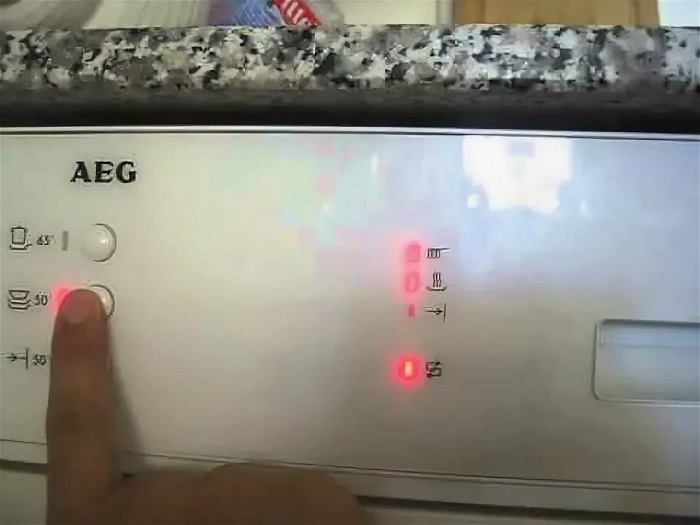
The E60 error in AEG dishwashers is most often linked to issues within the water-heating system: the appliance either fails to heat the water to the required temperature or detects incorrect heating parameters. This results in poorly cleaned dishes, cold water inside the tub, extended program durations, or the cycle stopping altogether.
Below are the typical causes of Samsung HC error, methods for initial diagnostics, and ways to address the malfunction. The recommendations focus on safe checks that can be performed without specialized tools, and they also clarify when it is best to stop attempting repairs and contact a service professional.
What the E60 error means and how the malfunction manifests
The E60 code typically points to a problem within the heating circuit—this could involve the heating element, temperature sensors, or wiring, as well as components that indirectly interfere with the heating process (such as those affecting water circulation or water levels).
The error may appear immediately after startup, midway through a program, or toward the drying phase—depending on the stage at which the controller expects a change in temperature.
Typical symptoms
- Water remains cold or barely warm during programs that require heating.
- The cycle takes significantly longer than usual or “freezes.”
- The E60 code appears on the display; the unit may stop and drain the water.
- Washing performance declines, leaving grease and residue on the dishes.
Common causes of the AEG E60 error and how to fix them
1) Electronic glitch or false trigger
Sometimes, the AEG E60 error is caused by a temporary malfunction, such as a voltage spike, a program “hang,” or an improper termination of the previous cycle.
- Unplug the dishwasher from the power outlet for 10–15 minutes.
- Plug it back in and start a short program that includes a heating phase.
- If the error persists, proceed to the checks below.
2) Insufficient water level or poor circulation
Proper heating depends on the dishwasher taking in the correct amount of water and maintaining stable circulation.
If there is insufficient water or it is not circulating properly through the system, the sensors may fail to detect the expected rise in temperature, causing the controller to trigger an E60 error.
- Check that the water supply valve is fully open and ensure the hose is not kinked.
- Clean the filters at the bottom of the chamber: the coarse mesh filter and the fine filter.
- Inspect the spray arms: the nozzles must be clear and free of limescale or debris.
- If the appliance is struggling to take in water, check the inlet mesh filter (located where the hose connects to the unit).
If the error persists after cleaning and ensuring proper water intake, the issue is likely electrical (involving the heating element, sensors, or wiring) or related to a malfunction in the circulation system.
3) Issues with the heating element (heater) or heating assembly
One of the most common causes of an E60 error is a faulty heating element or poor electrical contacts within its circuit. The heater may have burned out, developed a ground fault (leakage to the chassis), or be operating intermittently.
What you can safely check: look for signs of leaks underneath the unit, a burning odor, or melted insulation on the terminals (inspecting only accessible areas without disassembling any power-related components). If signs of scorching or moisture are detected, further use of the appliance is dangerous.
Accurately testing the heater with a multimeter—and replacing it—requires disassembly; therefore, if the E60 error recurs, a technician is usually needed.
4) Faulty temperature sensor (thermistor) or heating control circuit
If the temperature sensor provides incorrect data, the machine “thinks” the water is not heating up (or, conversely, that it is overheating) and halts the cycle, triggering the E60 error.
Other potential causes include oxidized connectors, damaged wiring, or a faulty control module.
- Check whether the error appeared following a wash cycle, particularly if there was high humidity around the appliance housing (e.g., due to frequent leaks or condensation).
- Inspect the condition of the plug and power outlet; a poor connection can sometimes lead to power interruptions and malfunctions in the heating system.
If the error persists after a restart and basic cleaning, the sensor and control circuit should be diagnosed by taking measurements and inspecting the connectors inside the appliance housing.
In some cases, users may confuse error codes between different brands—for example, an “HC” error (often associated with heating issues in other brands) is not a standard code for AEG appliances. Therefore, you should focus specifically on the “E60” code and the particular specifications of your model.
Symptom
Probable cause
Initial steps to take
Water remains cold; dishes are not clean
Heating element, temperature sensor, or poor water circulation
Clean the filters and spray arms; restart the unit; check the water intake
Program runs for an excessively long time
System fails to reach the target temperature; sensor malfunction
Restart the unit; check the water supply; ensure there are no blockages
Error appears immediately upon startup
Power supply issue; open circuit or poor contact in the heating circuit
Disconnect from the power source for 10–15 minutes; check the power outlet followed by professional service diagnostics.
Important: If the E60 error is accompanied by a burning smell, the circuit breaker tripping, signs of water leaking from the bottom of the unit, or unusual noises, disconnect the appliance from the power supply and shut off the water. In such cases, it is safer to proceed directly to professional diagnostics to prevent short circuits or damage to the control module.
Conclusion
To quickly narrow down the potential causes, always begin your troubleshooting with the basics: check the filters, impellers, hoses, the condition of the seals, proper loading, and the quality of the detergent. Regular maintenance and careful use significantly reduce the risk of recurring breakdowns and extend the appliance’s lifespan.
Summary: How to minimize the frequency of breakdowns
- Clean the filters and the drain area every few cycles, or at the first sign that cleaning performance is declining.
- Check the spray arms for blockages and ensure they can rotate freely; clean them if necessary.
- Monitor for leaks: inspect the door seal, hose clamps, and all hose connections.
- Prevent limescale buildup: use dishwasher salt and rinse aid, and periodically run a descaling or cleaning cycle.
- Avoid overloading the racks, and ensure that items do not obstruct the spray arms.
- Disconnect the power and water supply if the appliance will be left unused for an extended period, or if any suspicious symptoms arise.
- Contact a service professional if you notice a burning smell, if the circuit breaker trips, if error codes persist, if the water fails to heat, or if a leak cannot be resolved through simple troubleshooting steps.