
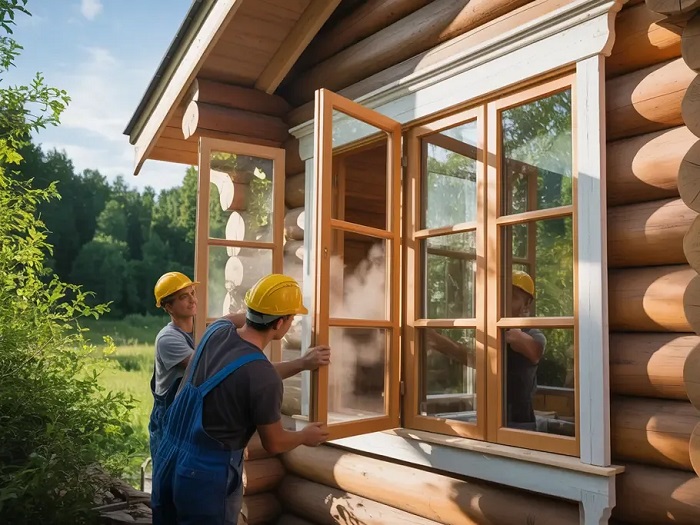
Replacing windows in a wooden house requires taking into account the characteristics of wood: a house “breathes,” changes geometry due to humidity and seasonal changes, and can also shrink. Therefore, the main task is to install new windows so that they don’t experience loads from the walls and maintain a tight seal during structural movement.
Proper installation techniques on https://www.diydoer.com/blog/home-window-replacement-in-chicagoland-for-comfort-and-efficiency help prevent sash warping, cracks, and frost, and extend the life of windows and trim. Below are practical guidelines for selection, opening preparation, and installation, applicable to both PVC, wood, and aluminum structures.
Preparation: What’s Important to Consider Before Dismantling
Before work, assess the condition of openings, crown moldings, and adjacent wall sections. If the wood has darkened, is crumbling, or shows signs of mold or leaks, first eliminate the cause and restore the foundation, otherwise the new window will not hold its shape.
Shrinkage and casing
The casing is a key element in a wooden house: it is an independent frame in the opening to which the window is attached. It allows the walls to move vertically without putting pressure on the frame and prevents warping.
- If there is already a casing, check it for integrity, absence of rot, and secure connections.
- If there is no casing, be sure to install it, especially in houses made of timber or logs.
- Leave an expansion gap at the top for shrinkage, which is filled with insulation, but not with polyurethane foam.
Measurements and design selection
Accurate measurements are taken along the inner planes of the casing, not along the log. Consider installation and alignment clearances.
- For colder regions, choose energy-saving double-glazed windows with a warm spacer.
- The profile width and seal quality are important: consistent air tightness is critical in wooden houses.
- Consider ventilation: micro-ventilation or supply valves reduce the risk of condensation.
Opening Diagnostics: When Repair Is Futility and a Complete Reinstallation Is Necessary
Before replacing a window in a wooden house with Warmdreams, it is important to assess not only the condition of the frame but also the window opening itself: the crowns, mullions, upper lintel, casing (jamb), and adjoining assemblies. If the load-bearing part of the opening has become weakened or its geometry is critically damaged, cosmetic repairs and “wedging” will only provide a temporary effect.
Complete reinstallation (disassembling the assembly down to sound wood, restoring the opening, and installing a new casing/window according to regulations) is required when defects affect the load-bearing capacity, dimensional stability, and airtightness, and localized repair is impossible without repeated warping and drafts.
Signs that opening repair is inadvisable
- Wood rot and deterioration in the casing/lintel support area, at the bottom crown, and at the fastening points: the wood crumbles, is easily pressed through with a screwdriver, and contains voids.
- Active biodegradability (fungus, mold) with deep penetration: Darkening, loose structure, characteristic odor, reappearance after drying.
- Critical loss of geometry: skewed opening, significant difference in diagonals, “screw” in which the window regularly jams, and gaps around the perimeter are uneven and increase over time.
- Destroyed or improperly executed casing: missing casing, no expansion gaps, posts do not have a sliding connection with the log/beam, the joint “holds” shrinkage and deforms.
- Cracks and splitting in the supporting elements of the opening (posts, lintel, crowns) with an opening passing through the section, or with “movement” under load/vibration.
- Chronic leaks and wetting of the abutment unit, due to whose wood has already lost its strength; Water stains are present on the top/sides, there is efflorescence, blackening, and delamination.
- Inability to ensure a proper installation joint: there is no room for a normal gap, insulation, and sealing, or the opening is so warped that the window cannot be installed without force.
Rule of thumb: If, upon opening the frame/slopes, it is discovered that there is insufficient “sound” wood for reliable fastening and support, the repair turns into endless adjustments and repeated rework – it is better to restore the entire opening immediately.
- Check the strength: carefully probe with an awl/screwdriver along the bottom of the opening, corners, and fastener points.
- Evaluate the geometry: measure the diagonals, verticals, and flatness; Compare the gaps around the perimeter of the old window/casing.
- Identify the source of moisture: the condition of the flashing, abutments, canopy/facade, top seam; without eliminating the cause, any patch will not work.
- Check the casing construction: is there sliding assemblies and expansion joints for shrinkage are missing; if these are missing, the assembly must be rebuilt.
Bottom Line: Replacing a window “inside the problematic opening” means allowing for distortions, drafts, and new leaks. If the opening is weakened by rot, damaged by moisture, does not maintain its geometry, or is constructed without proper casing, it is more rational and reliable to perform a complete reinstallation, restoring the wood and the shrinkage joint, and then install the new window.